

Illustration and maquette by David Versluis. Piece is entitled: “Enlaced,” © 2011.
Scale: eighteen feet high x seven feet wide.
The design of this sculpture is guided by a sense of an intertwining of a Christian perspective that’s found within Dordt College’s academic community. This sculptural piece tries to convey this aspect by weaving together seven upright metallic forms. The individual upright pieces are grouped into a regular pattern and yet suggest variety with unity through the columns of different heights. The goal is to develop a symbolic respite on campus, whether the piece is placed within a new landscaped sculpture garden or simply juxtaposed with existing buildings and pedestrian walkways.
The rusty patina of steel surface suggests an honest character produced by natural environmental elements. COR-TEN® steel forms a stable rust-like appearance when exposed to the weather for several years.
The sculpture is comprised of seven columns, which to some extent allude to the Hebraic biblical symbolism of seven branches of the traditional temple lamp-stand called the menorah (Exodus 25:31-40). The menorah is thought to symbolize the burning bush as seen by Moses on Mount Horeb (Exodus 3). In addition, the design of the menorah suggests the six branches of human knowledge, which are symbolically guided by the seventh branch representing the light of God.
Psalm 19 talks about the ways in which creation reveals God’s patterning in beautiful poetic language. Emphasizing the import of the “burning bush” analogy Calvin Seerveld writes in Rainbows for the Fallen World:
“Psalm 19 is enough to leave you limp. It makes vivid that all creation is a burning bush of the Lord God, revealing his just, merciful presence by the praise of countless creatures. It sings the glory of the law and ordinances by which Yahweh’s mouth rules all goings on in history with wisdom and compassion … and … it ends by confessing … that in keeping the law and in doing what’s right there is no justification … [God] save us! … Set us free from our sinful selves to be your willing servants, Lord!”
This sculpture celebrates the common reality found in Psalm 19 in which all human beings exist. If implemented a sculpture area would be a public space — a place where the Dordt community could congregate, meet, talk, and interact.
Referenced materials:
Strauss, Gideon. “Wonder, Heartbreak and Hope.” Capital Commentary. The Center for Public Justice, 28 Jan. 2011. Web. 23 Feb. 2011.
Seerveld, Calvin. Rainbows for the Fallen World: The Aesthetic Life and Artistic Task. Downsview, Ontario: Toronto Tuppence Press, 1980. 17. Print.
Monday, April 4, 2011
Dordt College Art Committee: Concept proposal for an East Campus Sculpture

Friday, April 1, 2011

herbert bayer’s monochromatic space-painting and the design of self-contained sculpture
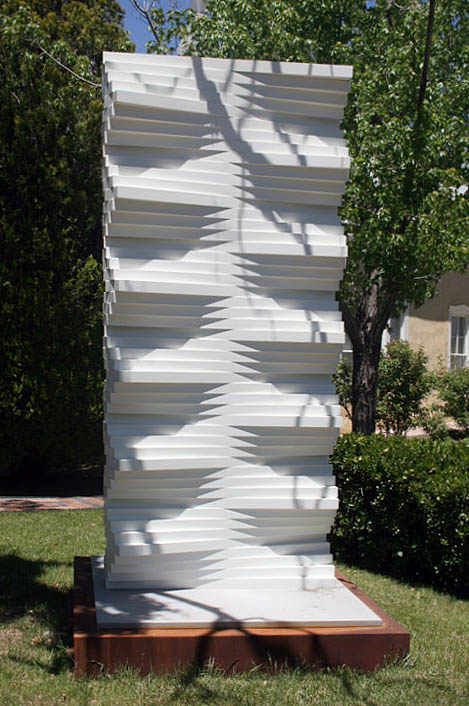
Undulated Wall
Herbert Bayer (1900-1985)
Powdercoated aluminum on a COR-TEN® steel base.
c.1967/2007
Bayer’s sculpture was photographed May 2009 at the Peyton Wright Gallery in Santa Fe, New Mexico. Photograph was taken with the gallery’s permission. We wish to thank the gallery for their graciousness. Photography by versluis by ©2009.
Although written in the context of a different project what Bayer says below seems apropos for this sculpture as well:
vistor, walking around…, experiences varying views and impressions. by walking through space-painting, he becomes participant in space-time concept.… changing shadows, the tree, [retinal vibrations], contribute to impressions.… [1]
- Bayer, Herbert. Herbert Bayer: Painter, Designer, Architect. New York: Reinhold Publishing Corporation, 1967. 140. Print.
Tuesday, March 29, 2011
Classic Roman Style Letters

This photograph shows just a portion of the stone carved lettering, which indicates the entrance to the archaeological Crypt beneath Notre Dame in Paris. Photograph by versluis © 2010.
From Cathédrale Notre Dame de Paris:
The archaeological Crypt under the Parvis de Notre-Dame de Paris was built to protect the ruins discovered during the excavations that began in 1965, conducted by the Commission du Vieux Paris. The crypt was opened in 1980 with the aim of presenting elements from the successive buildings constructed on the site from Ancient [Roman] times to the 19th century.About Roman lettering Phil Baines and Andrew Haslam write in their book, Type & Typography:
[Iowan] Edward Catich put forward the theory that the stone V-cut letters of Trajan’s Column were not merely the product of a skilled stone carver using a chisel. He suggested that the letters were first painted onto the carving surface, allowing the spelling and length of the inscription to be checked before carving. A skilled calligrapher, Catich recreated the strokes he considered necessary to the structure of each letter.
A brush creates letters differently from a pen: it is turned as it makes strokes, and different amounts of pressure can be applied to create thick and thin marks. [1]
- Baines, Phil, and Andrew Haslam. Type & Typography. New York: Watson-Guptill Publications, 2002. 41. Print.
Saturday, March 26, 2011
Good Taste, Bad Taste and the Amusement Factor

Photograph by versluis, copyright © 2011
Located on the east side of the small city of Pocahontas, Iowa is this monumental, twenty-five foot tall Pocahontas statue. This amusing statue is an attention grabber on Iowa’s Highway 3 where the road is a commercial strip through town. Pocahontas is namesake of the city and county and the statue is an emblematic “signature” of community values and virtues. The legendary story of Pocahontas is an endearing icon of honesty, respectability, and hospitality.
While the statue is not meant for commercialism, it does however fit into the architectural idiom of vernacular commercial forms. Presumably the attraction with its folk-art charm helps the economy of the area.
A plaque on the skirt indicates that Albert J. and Frank W. Shaw erected the statue in 1954. An armature and an applied surface utilizing a combination of cement and stucco, is a stable construction material that readily accepts paint pigments, support the structure.
The Pocahontas statue fits into the vernacular commercial builders portfolio along with “the giant ducks, giant milk bottles, giant coffee pots and other curiosities that once lined America’s highways. Ironically, the elements of this antiestablishment aesthetic have recently been co-opted by arbiters of [good] taste as [unvernacular and outsider art].” [1]
- Rubin, Barbara. “Aesthetic Ideology and Urban Design.” Common Places, Readings in American Vernacular Architecture. Ed. Dell Upton and John Michael Vlach. Athens, Georgia: University of Georgia Press, 1986. 482. Print.
Wednesday, March 23, 2011
AIGA Dordt College Student Group Event: John Vander Stelt

Wednesday, March 30 — 4 to 5 p.m.
Dordt College Department of Art and Design Lobby Display Area
John E. Vander Stelt has been in the graphic design field for nearly 25 years and has served clients in achieving a variety of visual communication and marketing goals. Currently, John is the creative director and graphic designer responsible for developing the graphic identity, advertisements, and various print collateral for Pizza Ranch, which is based in Orange City, Iowa.
In addition, John is an artist who has embraced his subject matter of family and small-town life. His love for art goes back to his childhood and his inspiration is sought in the family and small–town life he loves. Vander Stelt lives and creates his work in his studio in Maurice, Iowa.
Vander Stelt is a native of Maurice, Iowa and it is there, in the midst of the Heartland, where he seeks the inspiration for his work. Vander Stelt takes a traditional approach to the realism, which pervades his subjects. His artistic heroes include his Grandfather (John Vander Stelt, Sr.), Edward Hopper, Thomas Eakins, Grant Wood and Norman Rockwell.
John studied art from an early age and comes from a family with a creative spirit. The artist's friends, family and small-town surroundings are crucial elements in his work. He graduated from Northwestern College in Orange City, Iowa with a degree in fine art. His artwork is included in public and private collections throughout the country.
Monday, March 21, 2011
Chicago Tribute Marker for László Moholy-Nagy

Photography credits (clockwise, starting upper right):
Set design for “Things to Come,” used on the cover of the brochure for The New Bauhaus. c. 1936. Photograph. Moholy-Nagy Foundation, Ann Arbor. Web. 21 Mar. 2011.
Versluis, David. Chicago Tribute Marker for László Moholy-Nagy. 2011. Photograph.
The Chicago Tribute Marker for Moholy-Nagy states the following:
László Moholy-Nagy
Artist and educator
1895–1946
László Moholy-Nagy came to Chicago in 1937 to direct the New Bauhaus, an experimental art and design school. One of the most creative personalities of his time, Moholy-Nagy was a writer, painter, photographer, filmmaker, teacher, set-designer, builder of light-space machines, and philosopher of new aesthetics. He believed that art offered a way to reorder society after the traumatic years of World War I, and technology would pave the way.
Hungarian-born, Moholy-Nagy served in World War I and received a law degree before joining the faculty of the Bauhaus, a German school for the modern application of art and technology. He joined some of the most innovative thinkers of the day—Walter Gropius, Marcel Breuer, Wassily Kandinsky, Paul Klee, and Joseph Albers—and became a crucial figure in modern photography, pioneering the photomontage and developing the camera-less medium of the “photogram.”
The New Bauhaus, located in the old Marshall Field residence at 1905 South Prairie Avenue, closed for financial reasons after only one year. In 1939, Moholy-Nagy opened his own “School of Design,” which changed its name to “Institute of Design” in 1944. He directed the Institute of Design until his death. His textbook, Vision in Motion, became a standard text for art and design education worldwide. Moholy-Nagy lived here at 2622 North Lakeview Avenue.
